

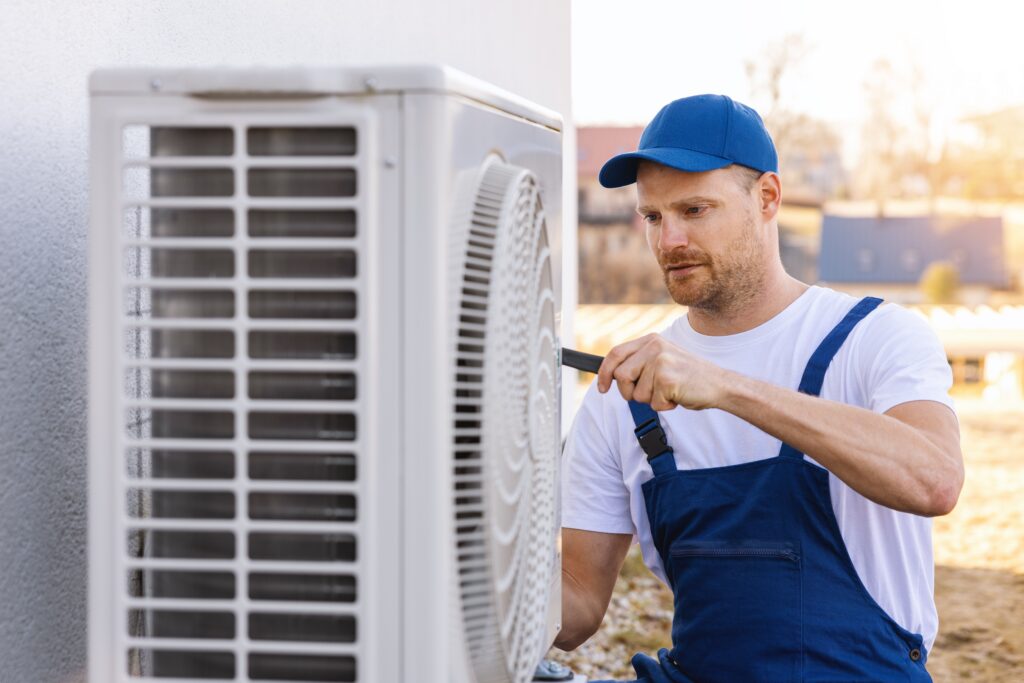
Most air conditioners give you three to six weeks of warning before they quit for good, and almost all of those warnings are easy to miss if you don’t know what you’re listening and looking for. At Vecchione Heating and Cooling LLC, the majority of the emergency calls we take in July could have been a routine air conditioner repair in May, for a fraction of the cost. Here are the five signals homeowners report most often, and what each one usually means mechanically.
1. The Air Coming Out of Your Vents Isn’t Really Cold
A healthy central AC system should deliver supply air roughly 16 to 22 degrees cooler than the air going into the return. If you hold your hand over a vent and the air feels merely “not warm,” that temperature split has narrowed, and something upstream is failing.
The usual culprits fall into a short list:
- Low refrigerant charge from a slow leak at a fitting, coil, or service valve
- A dirty evaporator coil that can no longer absorb heat from the airstream
- A failing compressor that’s still running but no longer pumping at full capacity
- Duct leakage in an unconditioned attic or crawlspace, which can waste 20 to 30 percent of cooled air before it ever reaches a room
Refrigerant is worth a special note. It isn’t consumed like fuel, so a system that’s low is a system that’s leaking, and federal rules under EPA Section 608 require a certified technician to handle it. Topping off without finding the leak just buys you a few weeks.
2. Your Electric Bill Jumped and Nothing Else Changed
This is the sign homeowners dismiss most often, usually by blaming the weather. But if your usage climbed 15 to 40 percent over the same month last year while your thermostat setting, occupancy, and rate plan stayed the same, the machine itself is the variable.
Here’s the mechanics behind it. As components degrade, whether that’s a coil packed with dust, a capacitor losing microfarad capacity, or a charge that’s drifted low, the system loses cooling capacity per minute of runtime. It still has to satisfy the thermostat, so it simply runs longer, and every extra minute of compressor and blower operation shows up on the bill.
A unit that once cycled for 15 minutes and shut off may now run 35 minutes to accomplish the same thing. The house feels roughly the same, which is exactly why the problem hides. The U.S. Department of Energy notes that cooling accounts for a significant share of household electricity use, and its guidance on central air conditioning is a useful reality check on what normal operation should cost you.
Compare two or three consecutive bills against the same months from the prior year before you call. That data point genuinely helps a technician narrow the diagnosis. Scheduled AC maintenance in Penndel and the surrounding towns catches most efficiency losses before they reach your statement.
3. New Noises You’ve Never Heard Before
Every system has a baseline hum. What matters is the sound that wasn’t there in May. Different noises point to genuinely different failures, and a few of them are the difference between a $250 part and a $6,000 replacement.
- Screeching or squealing at startup: worn blower or fan motor bearings, or a failing belt on older air handlers
- Grinding metal: bearings that have already failed, usually a matter of days before the motor seizes
- Rapid clicking at the outdoor unit: a failing contactor or run capacitor
- Loud buzzing or humming with no fan movement: electrical trouble, and a reason to shut the system off at the breaker
- Rattling that changes with fan speed: loose hardware, or debris inside the condenser cabinet
A hard clunk when the compressor engages deserves attention the same week. Compressors are the single most expensive component in the system, and hard-starting under electrical stress shortens their life measurably.
4. Short Cycling, or a System That Never Shuts Off
Watch your unit through one afternoon. A properly sized system on a 90 degree day should run in cycles of roughly 10 to 20 minutes, several times an hour, with real off periods in between.
Two abnormal patterns matter. Short cycling means turning on and off every three to five minutes, which typically points to an oversized system, a restricted airflow problem, a refrigerant issue, or a thermostat placed near a heat source. Continuous running during moderate weather, say 80 to 84 degrees outside, suggests the unit no longer has the capacity to reach setpoint.
Short cycling is mechanically brutal. Compressor motors draw their highest current at startup, so a system starting 12 times an hour instead of three is aging four times faster than it should. If your AC quits entirely during a stretch of high heat, emergency AC repair in Fairless Hills is available the same day in most cases.
5. Moisture, Ice, or a Smell That Wasn’t There Last Summer
Your AC removes humidity as a byproduct of cooling, and that condensate has to drain somewhere. When it doesn’t, you find out through your ceiling or your nose.
Look for these specifics:
- Water pooling around the indoor air handler or furnace cabinet, which usually means a clogged condensate drain line or a cracked pan
- Ice on the copper refrigerant line or on the indoor coil, a classic symptom of low airflow or low charge
- A musty odor when the system starts, indicating microbial growth on a wet coil or in the drain pan
- A sharp chemical or sweet smell, which can indicate a refrigerant leak and warrants shutting the system down
- Rooms that feel clammy at 74 degrees, meaning the system is cooling but no longer dehumidifying properly
If you find ice, turn the cooling off and leave the fan running to thaw the coil before a technician arrives. Running a frozen system pulls liquid refrigerant back to the compressor, and that’s how a repair becomes a replacement.
Frequently Asked Questions
How long does a central air conditioner last?
Most residential central AC systems last 12 to 17 years, with annual maintenance pushing units toward the upper end of that range. Systems in coastal or high-salt environments and those that were never serviced often fail closer to year 10.
How often should an air conditioner be serviced?
Once per year, ideally in spring before the first stretch of 85 degree days. Filters are separate: most 1-inch pleated filters need changing every 60 to 90 days, and more often in homes with pets or ongoing renovation dust.
Why is my AC running but not cooling the house?
The three most frequent causes are a low refrigerant charge from a leak, a dirty or iced evaporator coil, and a failed outdoor fan motor that leaves the compressor unable to reject heat. Check your filter and confirm the outdoor fan is spinning, then call for diagnosis.
Can I add refrigerant myself?
No. Handling refrigerant requires EPA Section 608 certification, and overcharging a system is one of the fastest ways to destroy a compressor. Low refrigerant also always indicates a leak that needs locating, not just topping off.
Noticing One of These Signs at Home?
Catching a failing capacitor or a slow refrigerant leak in April is a routine visit; catching it during the first 95 degree week is not. Contact us today to schedule a diagnostic with Vecchione Heating and Cooling LLC, and we’ll tell you plainly whether you’re looking at a repair or a replacement conversation.